
Read Menominee County Deed Records
The Register of Deeds records deeds and mortgages for all Menominee County land. Tax liens, sheriff's deeds, and UCC instruments are filed there too. Type matters. One document can transfer title or secure a debt. It can also release a prior claim or fix a description. Some execute a court or estate action. Treat no indexed row as a sale without reading the instrument itself.
| Deed Type | What It Does | Common Use |
|---|---|---|
| Warranty deed | Conveys the stated interest with title promises in the instrument | Arm's-length and other sales |
| Quitclaim deed | Conveys whatever interest the grantor holds without broad warranties | Family or interest cleanup transfers |
| Trustee or personal-representative deed | Transfers land under trust or estate authority | Trust and probate administration |
| Sheriff's deed | Records a conveyance after the applicable foreclosure process | Mortgage foreclosure trail |
| Tax-foreclosure deed | Records title after statutory forfeiture and foreclosure steps | Delinquent-tax property |
A mortgage or lien burdens an interest rather than passing ownership. Trace assignments, discharges, releases, and court dispositions before assuming an old claim still stands.
Menominee County's Vault Tract Index
Menominee County built its deed archive on an old-fashioned foundation. The county recorder's office description says the vault holds a physical tract index. It opens with the first U.S. government acquisition of each parcel. From there it moves to the first settler or buyer. Every deed and mortgage dealing follows, right up to the present day. That depth belongs to the vault itself, though. It does not mean every old entry appears as an online image.
The county has not stated when LandWeb's index begins. It also has not said when images start. Nor is it clear whether each old book was reindexed. So a failed online search is not the end of the road. Shift instead to the tract index, book and page references, and the legal description. The recorder staff can work the vault materials directly. The Register's official page lays out the office and its tract-index holdings for anyone planning that step.
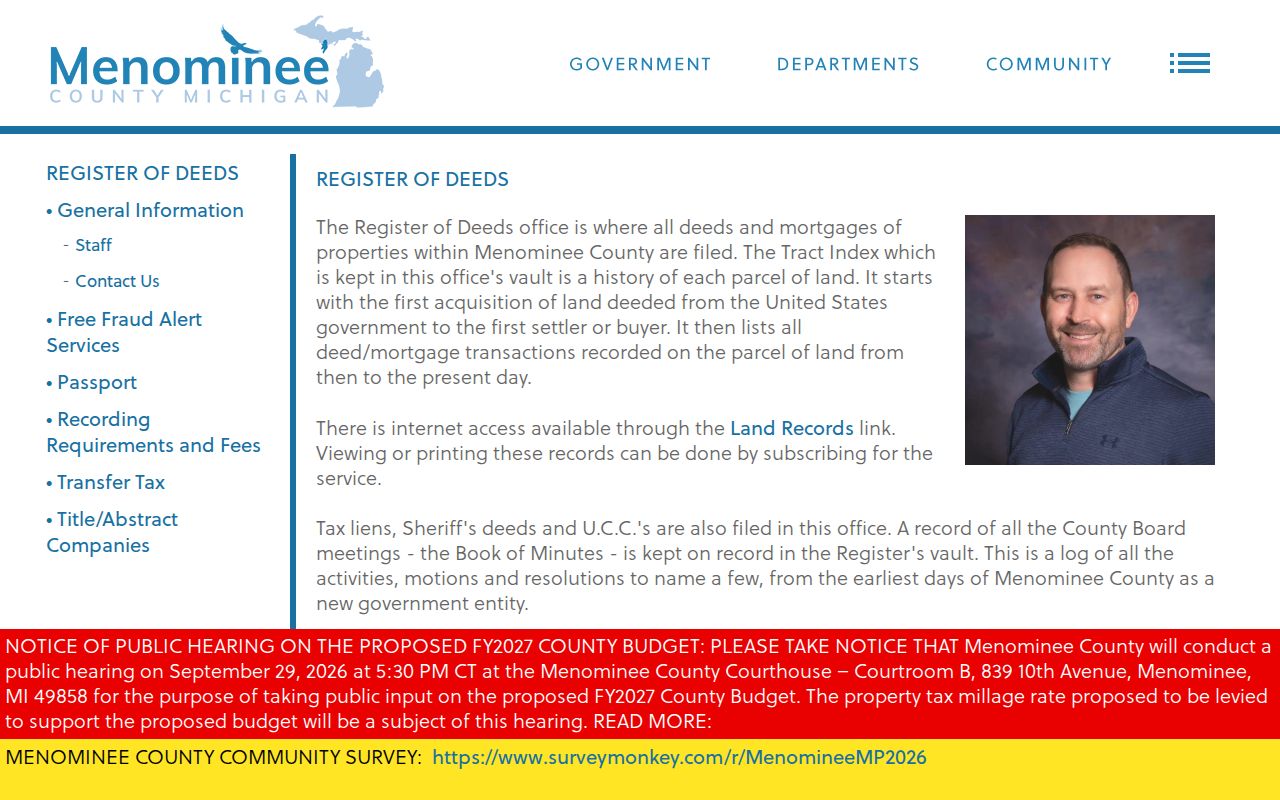
The official Register page ties the online route back to the office that keeps the controlling index and issues copies.
Note: Confirm LandWeb's current online span and image access with the Register before planning a remote-only chain search.
LandWeb Deed Access in Menominee
LandWeb is the county's subscription route for viewing and printing recorded material. The county publishes no live field labels. It lists no wildcard rules, result columns, image price, or date span either. Read those details from the current interface or confirm them with the Register.
Start with party names, the recording window, and the legal description. Keep the instrument number or book and page once results return. If a modern parcel number misses an old deed, try something else. Lot and block, the plat name, metes-and-bounds text, or the prior owner's name may work.
Follow Menominee's Grantor-Grantee Chain
A backward chain begins with the newest conveyance into the current owner. Read the seller's name from that deed. Then find the earlier deed where that seller acquired the same legal description. Repeat the step for each earlier deed. Keep every non-conveyance record separate from the deeds themselves.
- Find the latest deed where the assessed owner appears as grantee, the person or entity receiving the interest.
- Copy the grantor, date, document type, recording reference, and full legal description.
- Search that grantor as an earlier grantee and match the land description, not merely the surname.
- Move to the courthouse tract index and deed books when the online span ends or the parcel code fails.
- Grantor
- The party transferring the stated interest.
- Grantee
- The party receiving that interest.
- Chain of title
- The linked sequence of recorded conveyances for the same land.
- Book/page or instrument number
- The recorder's reference used to retrieve a filed document.
Menominee Deed Recording Standards
The county's recording requirements demand a legible instrument, printed signer names beneath signatures, the grantee's address, drafter information, proper acknowledgment, and one recordable event stated in the first line. Paper, margin, ink, and type rules also apply. A survivor may need certified proof of death. Court orders or judgments affecting title must be certified or sealed as required.
These rules explain gaps in a chain. A rejected instrument never joins the recorded record. Later corrections can fix a name or legal description, so follow related references rather than trusting the first document found.
Menominee Deed Fees and Copies
The published schedule sets a $30 recording fee no matter the page count. An assignment or discharge touching more than one instrument adds $3 per additional instrument. Plain copies of recorded documents cost $1 per page. A certified copy costs $5. A record search runs $0.50 per year with a $5 minimum.
Each amount buys something different. Recording places an accepted instrument into the public record. A plain copy serves research. A certified copy carries the recorder's certification when a process requires it. Confirm current charges and delivery with the office before sending funds.
The published fee page presents those charges beside the document standards.
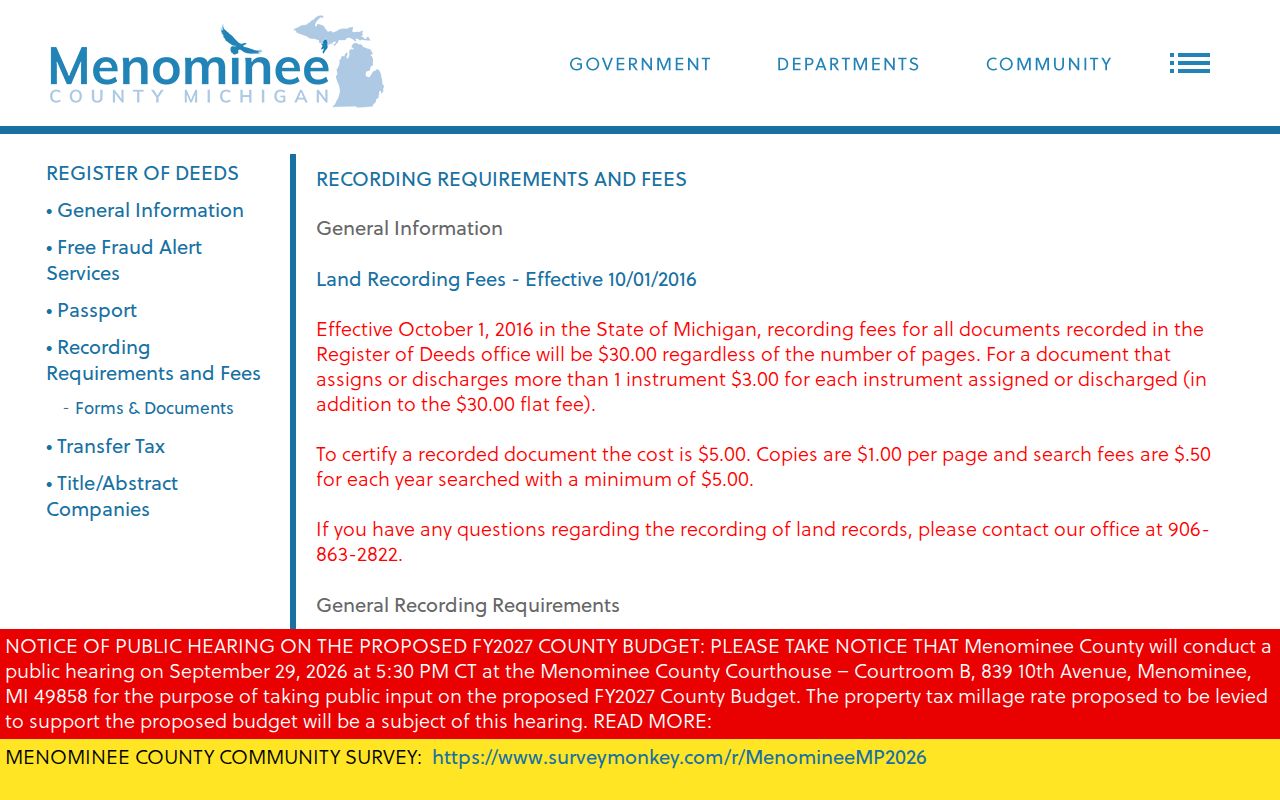
The image separates the price of recording a new document from the smaller cost of ordering a copy of one already on file.
Transfer Tax in Menominee Deeds
Transfer tax is collected at recording based on stated consideration. An exempt instrument must cite the applicable Michigan Compiled Laws number and paragraph on its face. Consideration is sometimes withheld for confidentiality. In that case, the county directs filers to submit a Real Estate Transfer Tax Valuation Affidavit.
The county transfer-tax instructions can help locate evidence of stated consideration. That figure is not the property's market value. Family transfers and partial interests can distort it. Exemptions and other terms can make it a weak stand-alone measure of price.
Probate and Survivor Deeds
Estate transfers can scramble a tidy deed chain. Consider a personal representative's deed, a trustee conveyance, survivorship proof, a certified death certificate, or a probate court order. Each one does different work. Match every one to the parcel's legal description. Remember that a will, by itself, never changes record title. The court's authority and the recorded instrument must line up in sequence. The chain makes sense only then.
MiCOURT can offer a public starting point for a case. It is not the clerk's file, though. Protected or specialized probate matters may not appear there. Ask the Probate Court clerk for the public docket and the copies that establish authority. Then take that authority back to the deed records to find the actual conveyance.
Free Menominee Fraud Alerts
The Register provides a free property fraud alert covering documents recorded under a monitored name. Treat it as an early warning, not a recording block. It proves nothing about whether a filing is valid.
Enroll every name variant that matters. When a notice arrives, check it against the recorder's actual index. Watch also for unexpected mail demanding steep fees for a deed copy. Michigan consumer guidance warns that official-looking solicitations may charge inflated rates. They do this for records the county sells cheaply. The county's alert-service page shows the official signup route.
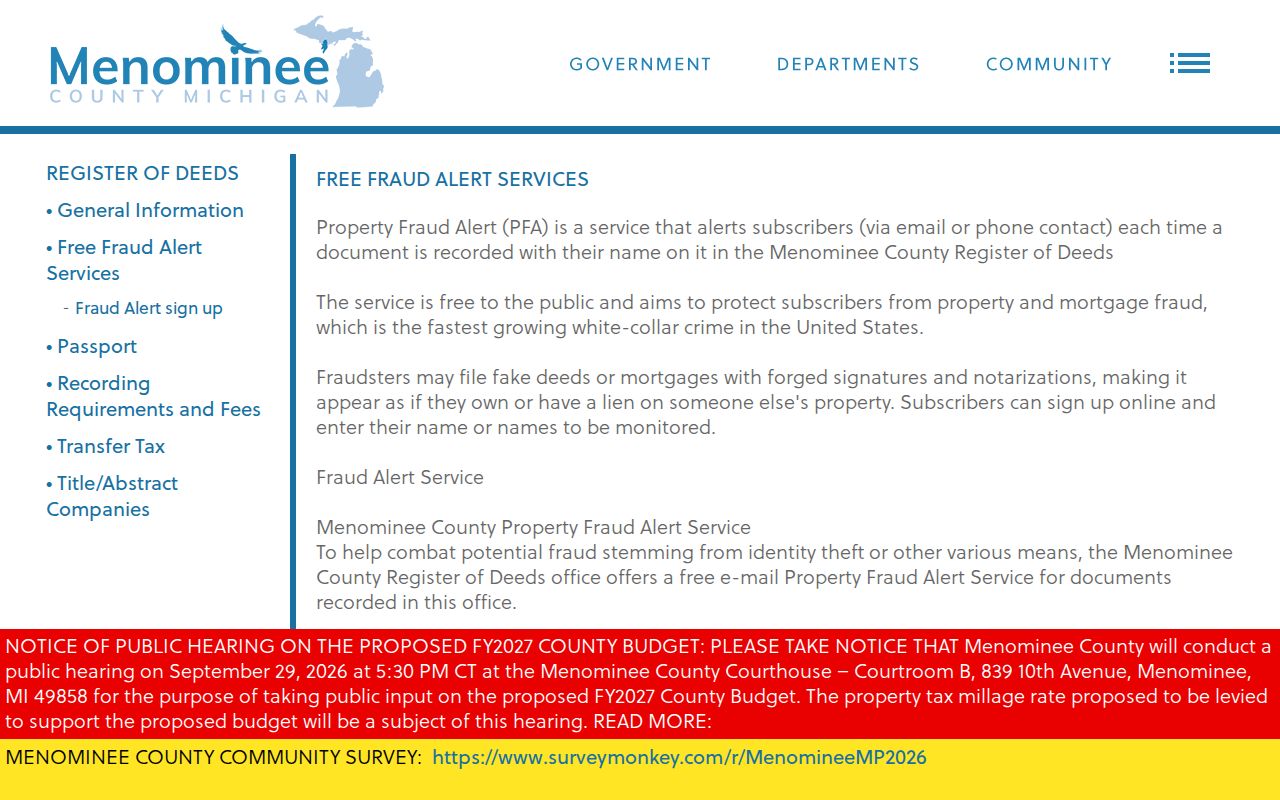
The service watches names in new recordings. Give name variants the same care you would bring to a deed-index search, since one missed spelling can skip a filing.
Historic Menominee Land Descriptions
Old maps can unlock old deeds. The 1912 Standard Atlas at the University of Michigan holds landowner maps plus village, city, and township plats, with directories. Later Library of Michigan holdings add map and plat resources from 1925, 1939, and 1963. Menominee County began as Bleeker County, took its current name when organized, and later saw its Wisconsin boundary argued to the U.S. Supreme Court. Period names matter when you read historic deeds.
Modern parcel names still echo that era. Assessor's Plat No. 1 and North Ludington Company's First Addition are two examples among many additions. Use those names to bridge today's parcel to an old plat. Let the recorded instrument, not the map alone, establish the chain.
Menominee Encumbrances in the Index
Deeds are only one strand in the recording system. Mortgages, assignments, discharges, liens, easements, restrictions, and notices sit in the same index. A mortgage assignment changes who holds the debt on record. It does not release the mortgage. After payment, the discharge or satisfaction is the filing to seek. A lis pendens works differently: it signals pending litigation without stating the outcome. Follow it to the court disposition and any later release.
Search owner names and lender or claimant names alike. Read the legal description closely. An instrument may touch the whole parcel or only an easement, lot, or partial interest. Some filings incorporate an older plat, covenant, utility right, or restriction by reference. Copy those recording references. Pull the cited documents rather than trusting a short index label to explain their scope.
Tax records run on a separate chain. An unpaid ledger, forfeiture, foreclosure judgment, county vesting, auction listing, and recorded tax deed mark distinct stages. A listing alone proves nothing about title. Confirm the statutory process. Confirm the recorded deed before slotting any tax event into the chain.
Obtain a Menominee County Deed Copy
Start with LandWeb if the image you need falls inside its subscription coverage. If not, contact the Menominee County Register of Deeds on the first floor of the courthouse at 839 10th Avenue, Menominee, Michigan 49858. The office lists (906) 863-2822 and weekday hours of 8:00 a.m. to 4:30 p.m., open through lunch and closed on holidays.
Give the office party names, an approximate date, an instrument number or book and page, and the parcel's legal description. Say whether you need a plain or certified copy. A narrow request saves you from paying for years of records that have nothing to do with the property.
Recorded, not guaranteed. Menominee County deed records show accepted filings, not a title opinion. Unrecorded interests or defects may require a title professional's review.