
Trace Menominee County Former Owners Backward
Former owners emerge from transfers, not from the name on the current tax roll. Begin with the newest deed for the right parcel. Its grantor was once the grantee. Follow that party to the acquisition just before it. Menominee County's physical tract index reportedly reaches back to the first U.S. government acquisition and runs to the present. The online LandWeb index publishes no universal start year, so older chains may still need the courthouse.
| Source | Years It Covers | Where Held | What It Shows |
|---|---|---|---|
| LandWeb deed index | Online cutoff not published | Subscription portal | Indexed instruments and parties |
| Physical tract index | First U.S. acquisition to present | Register of Deeds | Recorded parcel history |
| Deed books and plats | Older recorded eras | Recorder vault and archives | Transfers and legal descriptions |
| 1912 county atlas | 1912 snapshot | University of Michigan digital collection | Historic owners, plats, and place names |
Online searching works well for recent transfers. Keep the parcel constant while the names change. For early links in the chain, lean on the legal description, plat, lot, block, section, and tract-index references, and treat an atlas or directory as a clue rather than a deed.
Begin Menominee County History in LandWeb
The LandWeb subscription portal opens the recorder index. Search the present owner's exact recorded name first. Then try reasonable variants, capturing document type, recording date, and reference for the newest deed affecting the land.
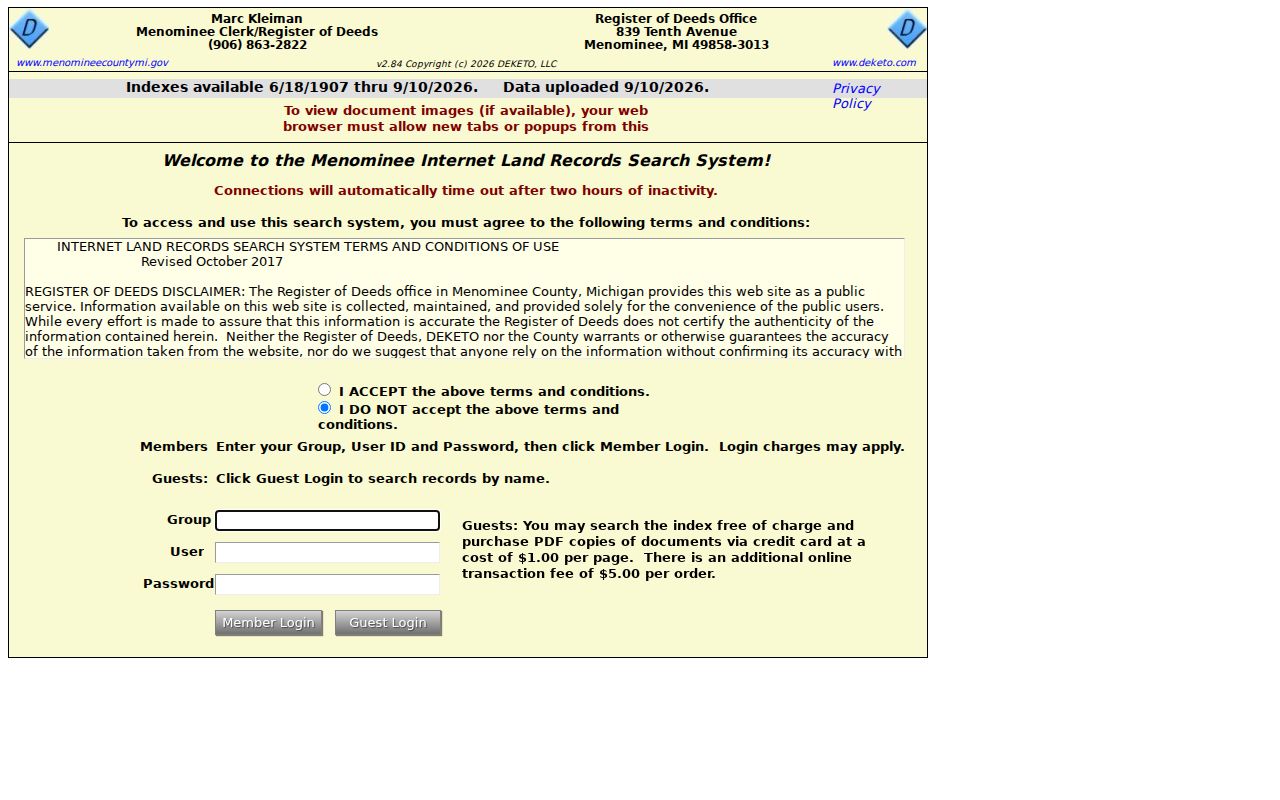
The portal's landing screen confirms access to the recorder index. It names no first searchable year. The landing page also says nothing about which older images are online. Save every reference before leaving a result.
Note: A same-name result is not enough. Match its legal description to the parcel before adding anyone to the chain.
Decode Menominee County Prior-Owner Terms
Index vocabulary makes the backward walk easy to audit. A grantor conveyed an interest. A grantee received what the instrument described. A chain of title ties those events to the same land, and a reverse index lets you lead the lookup from either party role.
- Warranty deed
- A conveyance with stated title covenants.
- Quitclaim deed
- A transfer of whatever interest the grantor may have, without the same covenants.
- Book and page
- A traditional volume reference for retrieving a record.
- Instrument number
- A unique identifier assigned at recording.
A recording is not a title opinion. Neither is an index entry, since corrective deeds, easements, liens, and probate events can reshape the record without forming a simple sale sequence.
Reconstruct the Menominee County Deed Chain
Keep the land fixed while people and entities change. Historic addresses often fail to match today's situs, so the legal description becomes the essential control across every generation of the deed chain.
- Find the newest deed and note its grantee, grantor, date, type, and recording reference.
- Search that grantor as an earlier grantee, allowing for initials, spouses, estates, trusts, and entity suffixes.
- Compare the legal description and reject a matching name tied to different land.
- Repeat until the target date or online limit, then continue through the tract index and deed books.
- Grantor and grantee
- The conveying and receiving parties named by an instrument.
- Chain of title
- The linked sequence of recorded interests in the same land.
- Legal description
- The land description that outlasts a street-address change.
Bridge Menominee County Splits and Estate Events
A parcel split can make the chain stop cold. Combinations and corrective deeds do the same. Compare parent and child descriptions, acreage, lot and block, and recorded plat references, remembering that a new parcel code is an administrative clue rather than proof the earlier history vanished.
Death transfers add probate orders, survivorship language, certified death proof, and a later deed. Sheriff and tax-foreclosure deeds count as well. They are ownership events, not ordinary sales. Date each event and note its document type before stepping farther back in the chain.
Reconnect Former Owners with the 1912 Atlas
The 1912 Standard Atlas of Menominee County collects historic plats, owners, townships, villages, and city material. An old subdivision or addition name can bridge a modern parcel to deed-book vocabulary. That helps most when an address search fails.
The county Treasurer's 2022 plat book offers a current paper-map fallback, sold at local points in Menominee, Stephenson, Powers, Bark River, and Escanaba. Maps identify likely land. Recorded deeds still prove ownership.
Search the Era When Menominee Was Bleeker
Menominee County was once Bleeker County. The Michigan-Wisconsin boundary even figured in litigation. Those facts seed alternate names in archive descriptions. Date each source and reconcile it with the parcel description instead of assuming a modern county label appears everywhere.
The Library of Michigan county guide, Archives of Michigan holdings, and the Menominee County Historical Society add newspapers, directories, plats, and name clues. Each is a clue source. None replaces the recorded chain of title.
Build a Menominee County Archive Route
Few counties offer this many research collections. The University of Michigan atlas supplies a mapped 1912 snapshot. The Library of Michigan county guide points to newspapers, maps, plats, directories, and owner-index material. The Archives of Michigan guide covers assumed-name, co-partnership, corporation, lien, cemetery, census, and vital holdings. The Historical Society's Anuta Research Center in Menominee keeps newspapers, photographs, books, records, and indexes. The county library also runs an obituary-request service.
Work these sources in order when a deed name resists identification. A directory may place a person in a town. A newspaper may explain an estate or company change. An assumed-name record can tie a business style to its legal party, which you then carry back to the recorder index. The chain stays grounded in recorded instruments.
Combine courthouse records in Menominee with local-history work. The county library's main branch sits in Stephenson. Historical Society visits round out the route. Contact each collection before traveling, because cataloged holdings and access arrangements differ.
Label Unusual Menominee County Transfer Events
A Menominee County deed chain often holds more than deeds. Mortgage discharges, liens, tax liens, sheriff's deeds, and tax-foreclosure instruments can sit right beside a transfer. None of them is automatically a sale. Label each document by its function before you place it on the ownership timeline.
The county's delinquent-tax path can end in foreclosure, county vesting, and auction. Auction listings are sold as is and may carry a buyer premium. They never prove that the winning bidder became the owner of record. Only the later recorded transfer shows that. Probate works the same way. A probate file can establish someone's authority to convey. Yet the land instrument itself still controls the recorded interest. A strong history notes the event and the deed together.
Corrective instruments deserve the same caution. A correction deed might fix a name, an acknowledgment, or a legal description. That is not a new negotiated sale. Read the parties, the consideration, and the description in context. A fresh recording date alone never signals a market transaction.
Measure Menominee County Ownership Time Depth
The county's physical tract index reaches back to first U.S. government acquisition of the land. It is the deepest ownership record available locally. The LandWeb portal does not state a cutoff year. There is also no courthouse-fire gap in Menominee County deed history to worry about. If an old parcel falls outside the portal's reach, the Register of Deeds holds the deed books, plats, and tract index that answer it. Skip guesswork and ask the office directly.
Former-owner research supports house history, estate work, purchase diligence, and title questions alike. Respect the privacy of living owners of record. Treat archive clues as leads for the property question at hand, nothing more.
Lawful use. Previous-owner records support land and house history. Never use them to track, intimidate, harass, or harm a living person.